
We may earn a commission from qualifying purchases at no extra cost to you.
3-Star vs 1-Star Ping Pong Balls what actually changes in bounce, durability, and price, plus 3 tested picks to help you choose.

Quick Answer
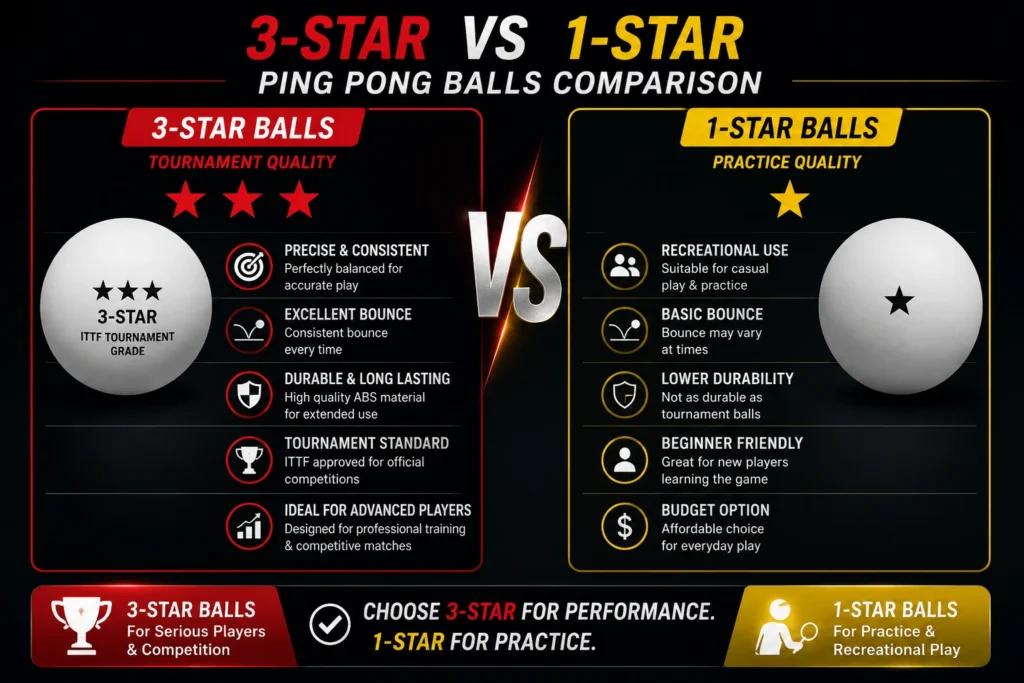
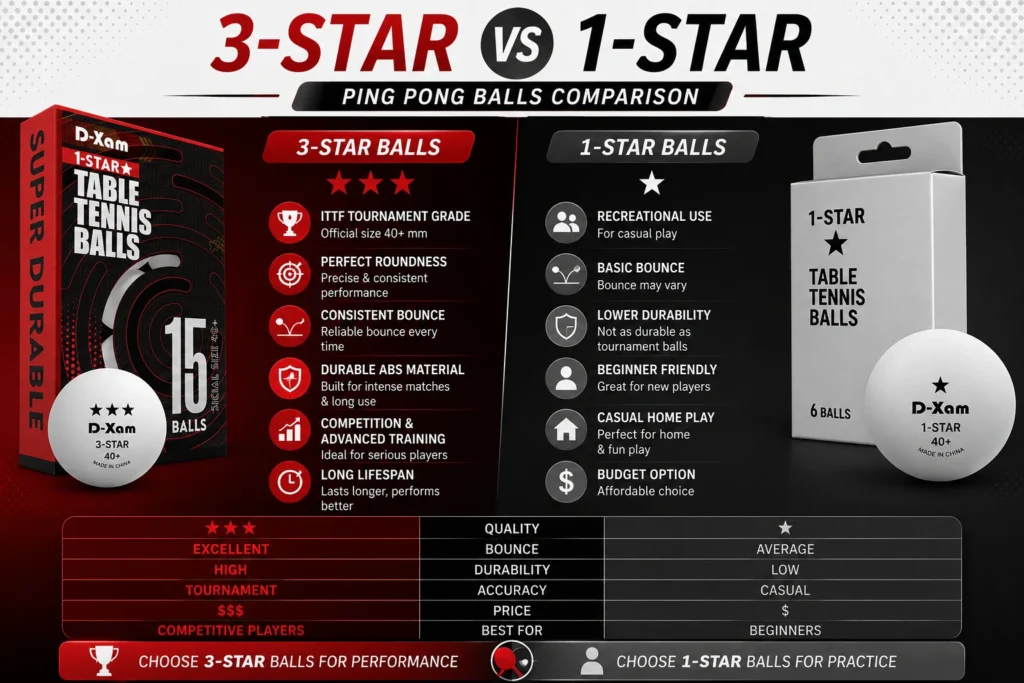
The difference between 3-star vs 1-star ping pong balls comes down to precision: 3-star balls go through tighter manufacturing checks for roundness and bounce, while 1-star balls are made fast and cheap for bulk use. If you’re serious about your game, go 3-star. If you’re stocking a training bucket or hosting a game night, 1-star saves you money without ruining the fun.
Why the Star Rating Actually Matters
Every ping pong ball gets a star rating from 1 to 3, and it’s not just marketing fluff. Understanding 3-star vs 1-star ping pong balls tells you how carefully that ball was made — how round it is, how consistent the bounce is from one ball to the next, and how well it holds up to hard smashes.
When people search for the difference between 3-star and 1-star ping pong balls, what they’re really asking is: which one is worth their money? A 3-star ball goes through stricter quality checks and is built to meet official ITTF standards, which is why 3-star ping pong balls are the only ones approved for tournament and league play. A 1-star ball, on the other hand, usually doesn’t get checked individually at all it’s made fast, sold cheap, and meant to be used in bulk. Neither one is “bad.” They’re just built for different jobs.
If you’re comparing ping pong ball star ratings for the first time, think of it this way a 3-star ping pong ball is the version a coach or club would trust for match play, while a bulk 1-star ping pong ball pack is what you reach for when you just need a lot of balls that won’t cost a fortune. That’s really the heart of the 3-star vs 1-star ping pong balls debate precision versus practicality.
Below, we’re comparing 3-star vs 1-star ping pong balls with three real products, so you can see exactly where the difference shows up in real life: two 3-star options and one 1-star bulk pack.
1. PRO-SPIN High-Performance Ping Pong Balls (3-Star)
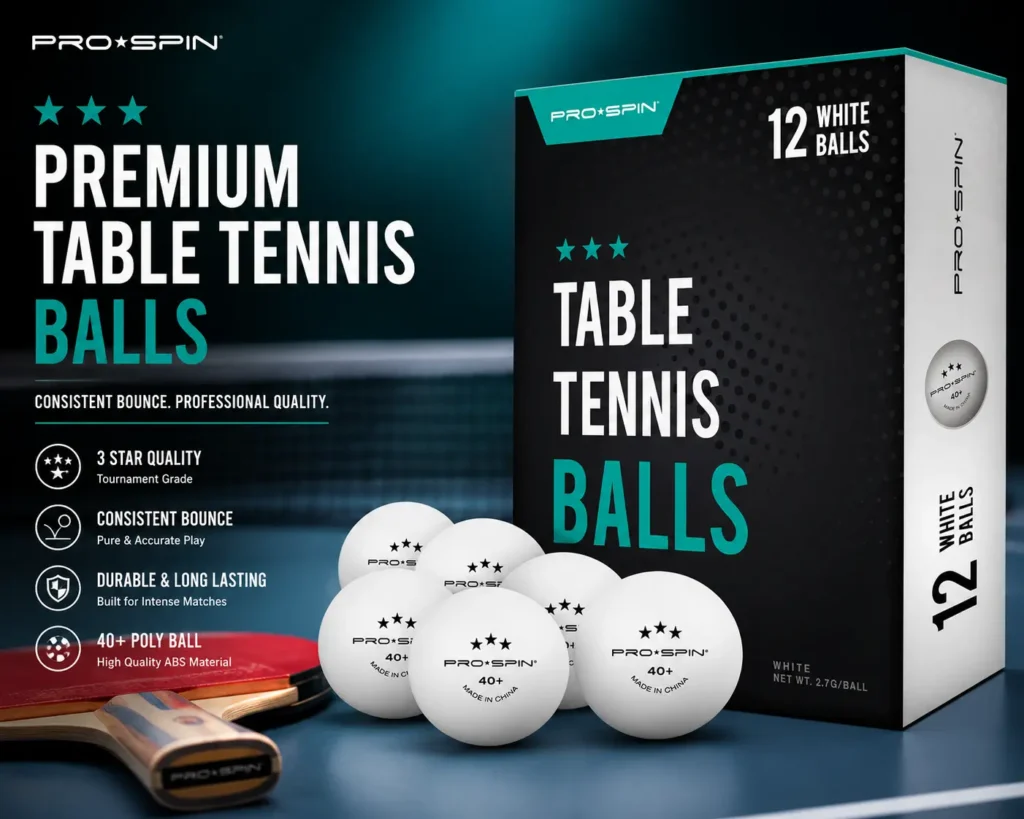
PRO-SPIN’s 3-star balls are made from premium ABS plastic and built to official size and weight standards, which means they behave the way a competitive player expects them to every time you pick one up.
What stands out here is the range of pack sizes. You can grab a pack of 12 if you just want to try them, or go straight to the 60-pack if you’re stocking a home table or small club. The brand backs every order with a replacement guarantee, so if a ball shows up damaged, you’re not stuck with it.
Key Features:
- Premium ABS plastic construction, official size and weight
- Available in 12, 24, or 60-ball packs
- Consistent bounce built for competitive and casual play
- Suitable for indoor and outdoor tables
- Backed by a replacement guarantee if balls arrive damaged
Pros:
- Reliable bounce that holds up across long rallies
- Multiple pack sizes for different budgets
- Durable enough to survive hard smashes without cracking
Cons:
- Bulk 60-pack is the better value; smaller packs cost more per ball
- Best suited to players who already own a decent paddle the ball’s quality outpaces beginner gear
Verdict: A dependable, no-surprises 3-star ball that works equally well for weekend players and anyone training seriously.
As an Amazon Associate, we earn from qualifying purchases.
2. JOOLA Training 3-Star Table Tennis Balls
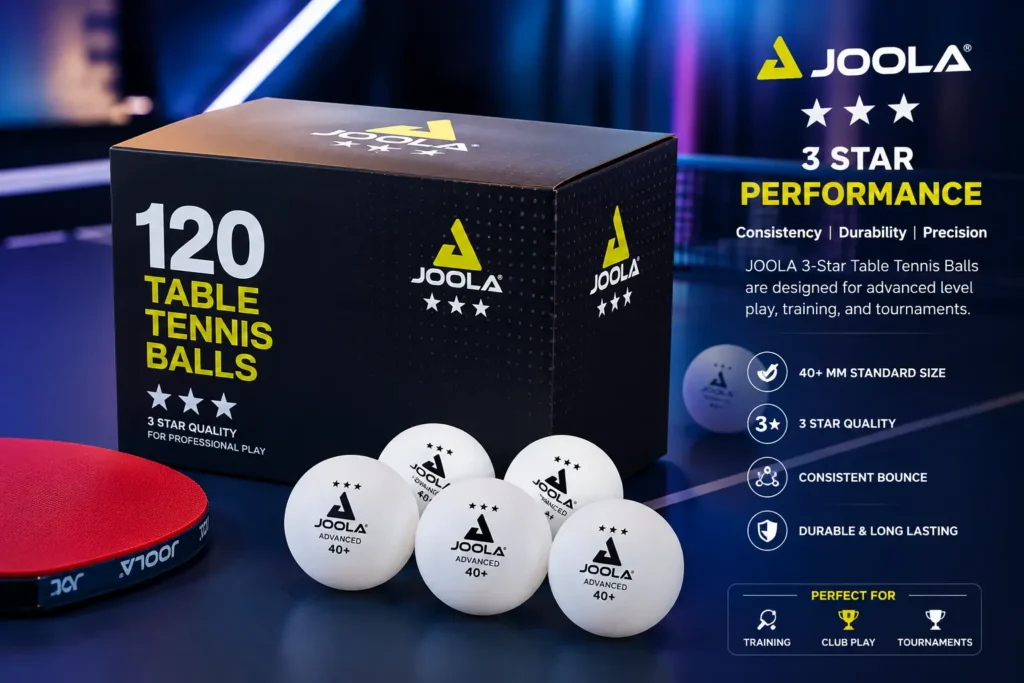
JOOLA has been making table tennis gear since the 1950s and has sponsored the Olympics, the World Championships, and the US Open so when they put a 3-star label on a ball, it’s coming from decades of tournament experience.
These balls are 40+mm, weigh 2.7 grams, and are 0.86mm thick, meeting official ITTF regulation size and weight. That precision is exactly what multiball training setups, ping pong robots, and club practice sessions need, since even small inconsistencies get magnified over hundreds of reps.
Key Features:
- ITTF regulation size (40+mm) and weight (2.7g), 0.86mm thickness
- Available in 12, 60, and 120-ball mega packs
- Designed for clubs, schools, recreation centers, and ball-machine training
- Backed by a table tennis brand with 60+ years in the sport
Pros:
- Regulation-accurate specs make it ideal for serious practice
- Large pack options (up to 120) are great value for clubs and coaches
- Trusted brand history in professional table tennis
Cons:
- Overkill if you only play a few times a month for fun
- The 120-pack is a big upfront purchase if you’re not training regularly
Verdict: The best pick here for anyone training with a ball machine, coaching a group, or wanting tournament-accurate specs at scale.
As an Amazon Associate, we earn from qualifying purchases.
3. D-Xam Ping Pong Balls (1-Star)
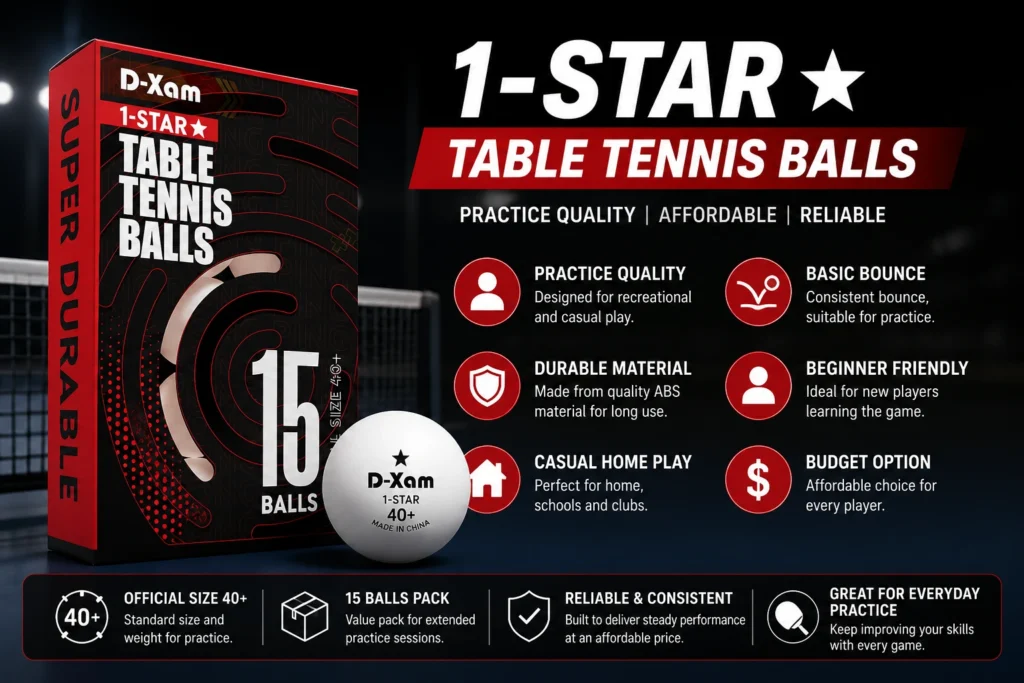
This is where the 1-star category earns its place. D-Xam’s balls are 40mm, made from ABS plastic, and sold in bulk packs 12, 15, 30, or 50 at a time which is exactly what you want when balls are going to get lost under the couch or smashed into the wall by a beginner.
They’re not trying to be tournament balls, and that’s fine. They hold their shape well, don’t develop that odd plastic smell some cheap balls have, and are genuinely useful beyond just table tennis plenty of buyers use them for beer pong, party games, crafts, or just letting kids bat them around.
Key Features:
- 40mm official size, durable ABS plastic
- Sold in bulk packs from 12 up to 50 balls
- No noticeable plastic odor, resists deforming with regular play
- Works well for casual games, parties, and craft projects, not just table tennis
Pros:
- Very budget-friendly for the quantity you get
- Great for beginners, kids, or anyone who loses balls easily
- Multi-use beyond the ping pong table
Cons:
- Bounce consistency won’t match a 3-star ball
- Not suitable if you’re practicing for competition or league play
Verdict: A smart, low-cost choice for casual players, families, and anyone who needs a big stack of balls without worrying about babying them.
As an Amazon Associate, we earn from qualifying purchases.
Side-by-Side: What Actually Changes Between 3-star vs 1-star ping pong balls
| PRO-SPIN (3-Star) | JOOLA (3-Star) |
|---|---|
| Best for: All-round competitive play | Best for: Club/team training |
| JOOLA (3-Star) | D-Xam (1-Star) |
|---|---|
| Regulation specs, higher precision | Budget bulk, casual use |
The short version, when you weigh 3-star vs 1-star ping pong balls side by side: both 3-star balls above are built to a consistent standard you can rely on shot after shot, while the 1-star pack is built for volume you’re paying less per ball because the factory isn’t checking each one individually.
Which One Should You Actually Buy?
If you play in a league, take lessons, or care about your shot accuracy, get a 3-star ball either the PRO-SPIN for general competitive play, or the JOOLA if you’re training with a machine or coaching a group.
If you’re setting up a casual game room, buying for kids, hosting a party, or just want a big bucket of balls that won’t break the bank if half of them end up outside, the D-Xam 1-star pack does the job without overspending.
A lot of serious players actually keep both around 3-star balls for real practice, 1-star balls for warm-ups, multiball drills, or anything where a ball is likely to get lost or damaged.
Frequently Asked Questions
Can you use 1-star balls in a tournament?
No. Tournaments and official matches require 3-star, ITTF-approved balls. 1-star balls are built for practice and casual play, not competitive accuracy.
What is the real difference between 3-star vs 1-star ping pong balls?
The main difference between 3-star vs 1-star ping pong balls is manufacturing precision. 3-star balls go through tighter checks for roundness and consistency, which means the bounce stays predictable across an entire game instead of varying ball to ball.
Is it worth paying more for 3-star balls if I’m just a casual player?
Not necessarily. If you’re playing for fun a few times a month, a 1-star bulk pack will feel almost the same and save you money. The difference shows up most when you’re training seriously or playing competitively.
How long do ping pong balls usually last?
It depends heavily on how hard you hit and how often you play. Both 3-star and 1-star ABS plastic balls are built to resist cracking, but hard smashes and outdoor play will wear any ball down faster over time.
What does the “+” mean in 40+mm ping pong balls?
It refers to the newer regulation-size plastic balls (as opposed to the older celluloid standard). Both 3-star and 1-star balls in this post use the current 40+mm/40mm sizing.
